Jabberwocky: translating nonsense to different languages
Cross-posted to Substack.
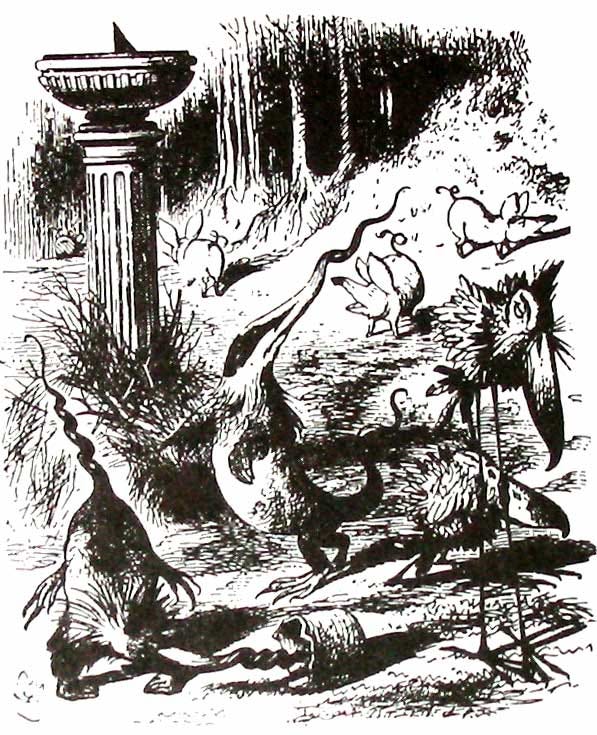
The beginning of Jabberwocky, the poem by Lewis Carroll, goes:
'Twas brillig, and the slithy toves
Did gyre and gimble in the wabe;
All mimsy were the borogoves,
And the mome raths outgrabe.
Despite scanning perfectly to English speakers, most of these words are nonsense. Translations typically translate the meaning of the original words, so how can you translate nonsense? The answer of course is that you translate the vibes or associations that native speakers get with the word.
The method of the Chinese translation
I conceived of translations of Jabberwocky being possible while researching Yuen Ren Chao, who translated it to Chinese. The very idea is genius; but also, how can you do it?
Chao’s translation attempts to produce the nonsense and atmosphere of the original by making up new characters that have the correct associations, and should be pronounced similarly to the original names. For example, the name “Jabberwock” is translated phonetically as “Zhà bó wò”, and means roughly ‘exploding-neck crouching dragon’.
How can Chao make new Chinese characters with similar vibes to the English nonsense words? Chinese characters are typically composed of several other characters. The component characters give an idea of the pronunciation, though there are no hard rules. For example, the first character of Jabberwocky (“zhà”, to explode), is composed of two characters: 火 (“huŏ”, fire) and 乍 (“zhà”, suddenly). The meaning is also sometimes intuitive from the components: when something explodes, it makes fire suddenly.
The first made up character is the last in the “Jabberwock” name, translated as “Zhà bó wò”. The character is “wò”, composed of 卧 (“wò”, to crouch or lie down) over 龙 (“lóng”, dragon). There’s a proposal to add it to Unicode so it can be represented, but in the meantime we’ll have to make do with just its components.
Because of these made-up characters, the only way Jabberwocky is currently represented in computers is as images. I’m working on an HTML version that can be studied, but in the meantime here’s a link to the images. There are other Chinese translations of Jabberwocky, but none of the widely-known ones create new characters
Catalan translations
Catalan also boasts several translations. In my opinion the translation “Estralejotí”, by Rubén Luzón Díaz (2024, in Valencian) is the best, with “El Barboteixot” by Amadeu Viana (1989) a very close second. Here is the first part of Luzón Díaz’s translation:
Estralejotí
Enrostidia en punt, i els tops lleugiviscosos
trepivoltaven ça i lla del gespar.
Bambaven, fluixerables, uns pocs borogovosos…
I els nomoverdiglars, vinga xiusclar!
This translation is really great: it is nonsensical and fun. It’s not quite as musical because of the longer verses, but that’s unavoidable in Catalan. However, in my opinion it surpasses the original in nonsense coinages. The nonsense makes more sense in Luzón’s Catalan version than in English.
How can the nonsense make more sense?
It’s not clear what “Brillig”, “slithy”, “toves”, and other nonsensical words mean from just reading the poem. However, Carroll very helpfully includes a character (Humpty Dumpty) who explains the meaning of several words later in the text.
For example, Carroll tells us that “‘Brillig’ means four o’clock in the afternoon, the time when you begin broiling things for dinner.” But that’s not clear at all from the sentence “‘Twas brillig”, instead of a time of day, it sounds like an adjective.
In Luzón’s version, “Enrostidia en punt” has two components that make it very clearly a time of day. “En-rosti-dia” has the “rosti” component, which is like the verb “rostir” (to roast), then “-dia” makes it a verb. The second part “en punt” means o’clock. Therefore, the Luzón’s version makes it very clear that it’s roasting o’clock, while keeping it all nonsense.
“Nomoverdiglars” is also much clearer than “mome raths”. Apparently a rath is “a sort of green pig”, but made much clearer in Luzón’s coinage: “verd” is green, and “-glars” is like “senglars”, which means boars.
Appendix: “Estralejotí” full translation
The full translation of Jabberwocky by Rubén Luzón Díaz.
Estralejotí
Enrostidia en punt, i els tops lleugiviscosos
trepivoltaven ça i lla del gespar.
Bambaven, fluixerables, uns pocs borogovosos.
I els nomoverdiglars, vinga xiusclar!—Ves alerta, fill meu, si ve l’Estralejot,
de queixos ferms i xarpada que ofén!
Compte amb l’ocell Jujú, i esquiva el carallot
frumiós més conegut per Bandaprén.—El xicot va empomar el seu glavi vorpal,
però al rival manxó no topetava,
així que s’aturà sota un arbre tantal
a embadocar-se ensems que cogitava.I mentre borinava amb l’ànim ufijós,
l’Estralejot, golut i amb ulls roents,
s’acostà bleixumer pel bosc atupissós,
barbullejant quimèric i suspens.Catacroc! Catacrac! Del dret i del revés,
l’arma vorpal va prorrompre a cascar.
D’un blast sec l’acorà, i el caparrot malmés
hissava galofant en retornar.—¿Has liquidat per fi l’Estralejot rufià?
Vine als meus braços, fill risirradiant!
Oh, jorn fabujoiós! Quin dia, idò… i oidà!
—rebufirreia el vell, més que exultant.Enrostidia en punt, i els tops lleugiviscosos
trepivoltaven ça i lla del gespar.
Bambaven, fluixerables, uns pocs borogovosos…
I els nomoverdiglars, vinga xiusclar!